Two-X Moto
Motorcycle Safety
One of the very first times I rode my motorcycle in traffic, was also the first time I crashed. I had begged my husband to let me just keep practicing around our neighborhood, but he wanted to ride ‘just down the street’ from our house to a local bike show that was going on. I reluctantly agreed and hopped on my bike wearing a thin pleather jacket, ¾ helmet and ankle boots. I made it through the first two traffic lights without any problems, then the first turn was coming up. I was in the left hand turning lane, waiting for my green arrow. My husband took off graciously first, then I followed less graciously. I was completely overanalyzing the situation, forgetting everything I had learned about turning. My first mistake was that I was looking down at the road, not at where I wanted to go. I soon learned that if you look down, you’re going down.
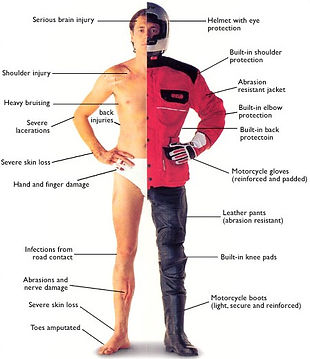
As a fairly new motorcycle driver, I am no expert. I know that I can constantly still be learning and improving this skill. I feel very strongly about teaching others the importance of motorcycle safety and feeling confident on their bike before getting pressured into going on rides before they’re ready. From experience, I see that people are sometimes oblivious to the importance of wearing the proper gear and protecting those that they ask to be their passenger. As a woman, I want girls to be aware of the dangers of being a passenger and making sure they trust the driver. And if they decide to be the driver, to make sure and wear the right gear, even if it doesn’t look that sexy. I propose that if you do decide to take a ride or drive on a motorcycle, to take a vow to ALGALT—All The Gear, All The Time.
Being the Passenger
Let’s talk about supersport bikes—or more commonly known as bullet bikes. One of my biggest pet peeves is riding down the freeway and a bullet bike, with a girl in short shorts and flip flops on back (neither of them wearing a helmet), goes flying past me going over 80 MPH. Sometimes my thoughts are ‘How stupid could that girl be?” or “How dare that guy let someone ride on back that’s not wearing any gear?”. In 2013, out of the total number of fatal motorcycle accidents of drivers under the age of 30, 58% were on supersport bikes. Now I’m not trying to pick on bullet bikes, they are very popular, especially to a younger crowd because the sitting position is uncomfortable for someone who is older. The biggest issue is the speed of these bikes, and the popularity of throwing a sexy chick on back. Now if you are the sexy chick that gets asked to “jump on back” or pressured by the sentence, “Let me take you for a ride”, think about your life. No matter how sexy you think you’ll look on the back, I assure you that you won’t look very sexy anymore with road rash and being brain dead. According to Lee Gaber, a Motorcycle Accident Attorney:
Here’s the formula for Road Rash: pavement or concrete, plus skin, plus velocity.
If severe enough, this injury can lead to exposed nerves, muscle, or even bones. Long term effects can include permanent nerve damage or infections. Thick, heavy clothing such as a leather jacket and gloves, or reinforced denim is the best preventative measure you can take.
Motorcycle accident statistics indicate that more than 35% of motorcycle crashes involve a major impact to the rider’s face. The most effective protection against permanent disfigurement is a full face helmet.
So if you do decide to take a ride with a friend, make sure you trust their abilities. Evaluate how long they have been driving this motorcycle, how seriously they take their lives, and make sure they aren’t a show off that may take it too far. Never talk yourself into not gearing up because you’re only going a short distance. According to Ehline Law, most motorcycle accidents happen at lower speeds of 30 mph or less, close to home, and during a trip that was intended to be quick. Your life is more important than looking good on a motorcycle.
Being the Driver
Master Sgt. William g. Dwyer, wrote an excellent article titled “Motorcycle Musts”. The beginning of the article, he has a heading titled “Stuff I Learned That Nobody Thinks Of For Some Reason." He brings up some excellent things to think about when driving a motorcycle. I want to focus on 5 of his main principles.
-
Check your turn signals.
-
Most motorcycles do not automatically turn their blinkers off automatically. This can confuse a car that might be behind you or a car may assume you’re turning and will pull out in front of you. Also double check that you turned off your blinker once your turn in complete.
-
-
Get out of blind spots.
-
Never, never, never ride in a car’s blind spot! Furthermore do not ride along next to a car if there’s any way to avoid it. Either fall behind or hit the gas and get past them. When you come to a stop, make sure and position yourself near the left side of the car in front of you so the driver can see you clearly in his side mirror.
-
-
Assume every car is going to pull out in front of you.
-
Always have the mindset that every car around you wants to be where you are. Evaluate every situation and ask yourself “What will I do if this car does X?” Always have an exit strategy.
-
-
Spend Money.
-
Don’t be cheap if you’re a motorcyclist, buy quality gear.
-
-
Know your bike’s limits and have the skills to exploit those limits when needed.
-
Practice swerving and know if you can stop your bike and how to control it with the brakes applied. Make sure you can handle to size of your bike as well, don’t buy a bike that you can’t handle and feel comfortable with.
-
I took the turn way too wide and dipped into the cement shoulder and lost my balance when my bike came too close to the curb and I tried to over correct. My bike simply tipped onto the curbside grass, and I was ejected and luckily landed in a pile of landscaping rocks. The shock of everything was setting in slowly, but the pain in my hands was the worst. I wasn’t wearing any gloves, and my hands ripped open where I had tried to brace my fall on the small sharp rocks. The thin pleather jacket I was wearing had scrapped off easily and left a good road burn on my hip; since I was wearing a ¾ helmet, my chin was bleeding as well. The rest of the damage was minimal, my brake pedal on my bike had broken through the engine side cover on impact, a small dent on my gas tank, and a few scrapes on my seat.
I was absolutely amazed that even though I was going less than 20 MPH, I still had this much damage. A simple mistake, quickly put me down. If only I had stuck to the code: ALGALT; I would have walked away easily without a scratch, grateful for not skimping on the proper gear for just a short ride.
I hope this inspired readers and fellow motorcyclists to take safety more seriously, and especially the safety of their passengers. Riding a motorcycle is a lot of fun, and something that shouldn’t scare people. Just be prepared and go through the proper training and you will be confident and prepared.
Work Cited:
Gaber, Lee. "Common Injuries According to Motorcycle Accident Statistics." Motorcycle Accident Lawyer. 18 Nov. 2014. Web. 14 Dec. 2015.
"Motorcycle Accident Statistics | Ehline Law Firm PC." Motorcycle Accident Lawyers. Web. 14 Dec. 2015.
"Motorcycles." Fatality Facts. 2013. Web. 14 Dec. 2015.
National Highway Traffic Safety Administration. 2015. Traffic safety facts, 2013: motorcycles. Report no. DOT HS-812-148. Washington, DC: US Department of Transportation
Rzepka Orion, Susan. "Riding Right: Finding the Best Riding Position for You." Women Riders Now. Web. 14 Dec. 2015.
"Why Should I Wear Protective Clothing On My Motorcycle?" Motorcycle Blog from JAFRUM. 17 Aug. 2011. Web. 14 Dec. 2015.